article
You Don't Notice Yourself Becoming Them.
How the people around us quietly shape our habits, standards, and ambitions.
- published
- 12 October 2026
- reading
- 8 min
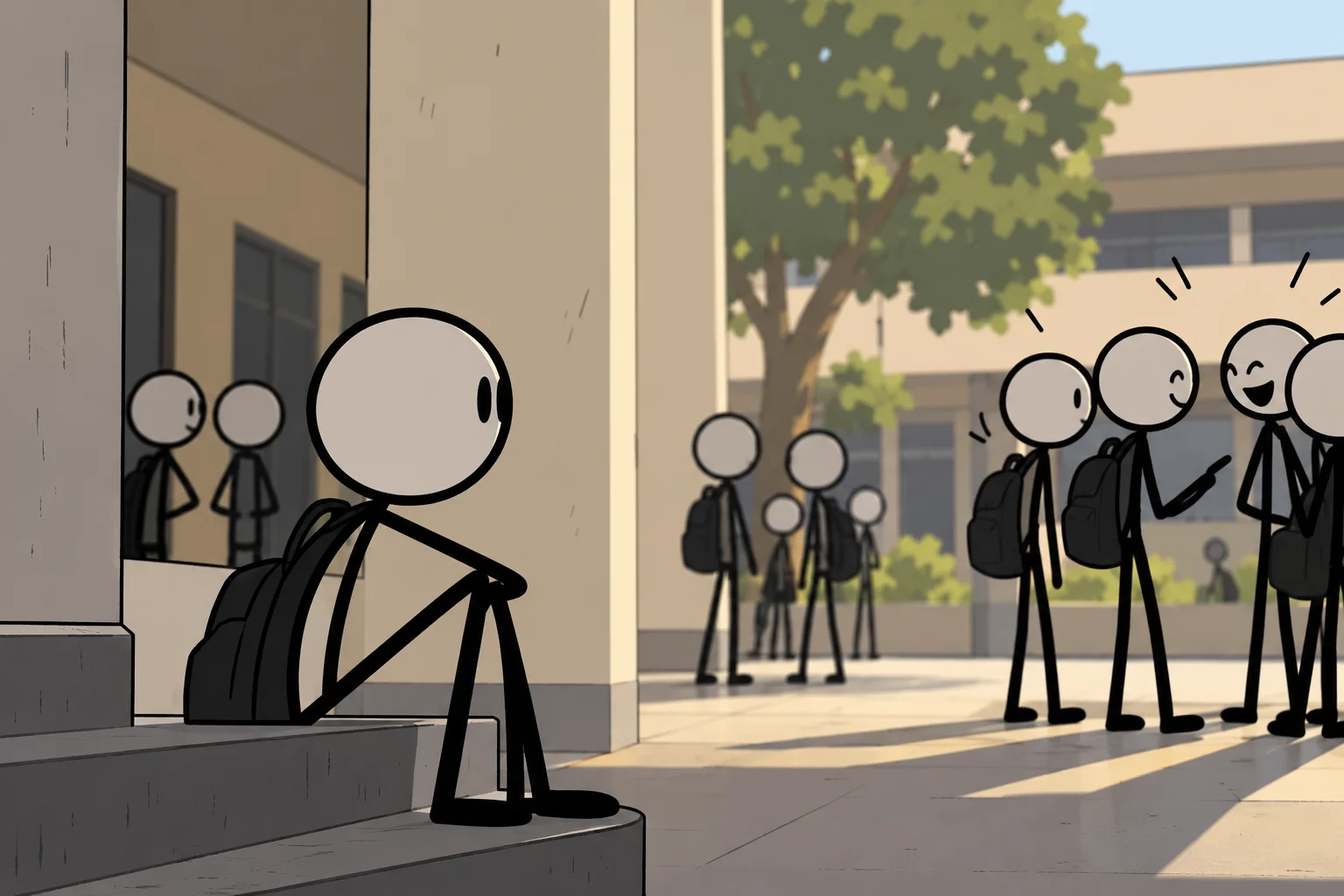
You Become an Average of the People You Spend the Most Time With§
I've noticed myself letting loose. I've noticed myself becoming someone I never thought I'd become — someone who, in certain ways, would have been unrecognisable to the people I used to spend my time with.
Let me explain how I came to this realisation.
When I was ten, I lived in the United States. I had a genuinely good group of friends. They were intellectual, playful, and serious when the situation demanded it. They had ambitions, and they weren't afraid to pursue them.
That was the key differentiator.
Everyone seemed to be building towards something. They wanted to get into top colleges, but not simply for the degrees or the prestige. There was something more important behind that ambition.
The peer group.
When I relocated back to India, my peer group, along with the academic system, was what troubled me the most.
I had what I can only describe as a sovereign mindset. I questioned authority. I questioned traditions and practices that had been passed down for generations. Not because I believed everything old was wrong, but because I didn't believe something was automatically right simply because it had existed for a long time.
I had been exposed to an environment that encouraged me to think independently, to ask questions, and to treat curiosity as something worth cultivating.
My experience after relocating was different.
In the peer groups I encountered in Bhavnagar, questioning authority was not always encouraged, even when I believed that authority was being misused. And slowly, I began to change.
I became more submissive.
Not necessarily because my convictions had changed, but because expressing them had become harder.
During my first year in India, I was bullied for my accent. But what bothered me more was that I was also ridiculed for my mindset.
Think about what that does to a person. When the way you speak makes you a target, and the way you think makes you one too, you begin to wonder whether fitting in requires you to change both.
And sometimes, without even making a conscious decision, you start doing exactly that.
Over time, I started picking up the way people around me spoke, behaved, and thought. Some of it was just a different way of living, and there was nothing wrong with that. But some of it was behaviour I didn't particularly respect, and yet I found myself copying it anyway. Not because I agreed with it, but because I wanted to fit in. I don't think one culture or dialect is inherently more sophisticated than another. The problem was that, somewhere along the way, I stopped asking myself whether the person I was becoming was someone I actually wanted to be.
Living in the States, I used to be rather aggressive, vocal and firm on my own points and beliefs. Coming to India, I became timid, shy, kept to myself. Why?
Maturity comes with age. I realized that I had a long life to live. Not everything deserves my confrontation. Not everything needs a response. Somethings, are just better left untouched. But this, for me, has evolved into fear. I kept telling myself that I have to have the highest virtues of integrity and discipline to stay out of fights and to not engage in violence.
This aspect of me, people have confused for fear, submissiveness, and shyness. And honestly? I too might be lost too.
I keep thinking that if I fight back, that'll affect my track record of never getting into fights or hurting people, and that this will affect me getting into a good college. I very well know my strength. Having trained Tae-Kwon-Do for 5 years, I know how to defend myself.
And that's what bothers me the most. I don't want to spend the next few years of my life being scared of people just because they have more friends than me. I don't want to keep apologising for things I haven't done wrong. And I definitely don't want to look back at myself ten years from now and realise that I let the people around me change me into someone I never wanted to become.
But then again, I have to ask myself. Am I actually becoming weaker, or am I just growing up? Because there's a difference between being scared to stand up for yourself and understanding that some things just aren't worth your time.
And honestly, I don't know where that line is anymore.
What I do know is that I don't want to lose the confidence I had when I was younger. I want to be able to speak my mind, question things, and stand up for myself without constantly worrying about what might happen afterwards. I don't want to pick fights, but I don't want to be scared of them either.
And this brings me back to the point I made at the beginning.
You become an average of the people you spend the most time with.
It's not just about picking up someone's accent, their jokes, or the way they behave. It's about slowly picking up their mindset, too. You start seeing things the way they do. You start accepting things you might never have accepted before. And sometimes, you don't even realise it's happening until you look back at who you used to be.
I experienced that firsthand. I moved from an environment where I felt comfortable questioning things to one where I often felt like I had to keep my opinions to myself. And somewhere along the way, I started doing exactly that.
I can't blame everyone around me for the person I've become. At some point, I have to take responsibility for myself, too. But I can acknowledge that the people around me have influenced me, and that I need to be more careful about who I allow to influence me in the future.
I don't want to become a copy of the people around me. I want to take the good from the people I meet, learn from their mistakes, and figure out what kind of person I actually want to be. Because at the end of the day, the goal isn't to become American, Indian, Kathiyawadi, or anything else. It's to take what I believe is good, leave behind what I don't, and build my own way of living. And maybe that's the real problem. We spend so much time trying to fit in with the people around us that we forget to ask ourselves whether we're even becoming someone we like.
Now coming to why I chose to write this article.
Recently, I've been only talking to people in my school, when I am on the bus. I am not going to take any names, but a kid, who is about as old as I am, cut another kids hair. 2 parts of his hair.
The blame came on me. Those were my so called friends. I used to talk with them, we used to have fun, but I didn't realize that I was becoming like them. I became more attached to rowdiness, rather than keeping calm on the bus. I enjoyed all this, which is what had a deeper and a more negative impact on me.
I'm not going to pretend like the day on which the boy's hair was cut, I wasn't joking about cutting his hair too. In jest I too had asked the boy to let me cut a single strand of his hair. But before I had a chance to, the kid who actually cut his hair, took the scissor from my hand and cut 2 parts of his hair.
Now, I could sit here and blame the kid who actually cut his hair. And yes, he was the one who did it. But that would be avoiding the bigger problem.
Why was I even participating in something like that in the first place?
A few months ago, I probably wouldn't have imagined myself getting involved in this kind of situation. But there I was, joking about cutting someone's hair, surrounded by people I considered my friends, enjoying the chaos without really thinking about where it could lead.
And that is what made me stop and think.
I wasn't being forced to act like them. Nobody was holding a gun to my head. I was doing it because I enjoyed being part of the group. I enjoyed the jokes, the attention, and the feeling of belonging.
Somewhere along the way, fitting in had become more important than asking myself whether I actually agreed with what was happening.
And I think that's the part we underestimate about the people we spend time with. They don't have to tell us to change. Sometimes, we change ourselves because we want to belong.
I for one, changed to fit in because I was scared, that I would be left out, and bullied like when I moved back to India. In the process of fitting in, I forgot what it felt to be different.
And that's something I need to change.
I don't want to spend my life trying to fit into every room I walk into. I don't want to change the way I think just because the people around me think differently. And I don't want to become someone I'm not just because I'm scared of being left out.
That doesn't mean I think everything about the person I was in America was perfect, or that everything about the person I've become is wrong. I'm still growing up. I'm going to change, and that's inevitable. But I want those changes to come from my own experiences, my own decisions, and my own understanding of the world, rather than simply being a product of the people around me.
Because the truth is, you can't always choose the environment you're placed in. You can't always choose the people you go to school with, the people you sit next to on the bus, or the people you see every day. But you can choose what you learn from them, what you accept, and what you refuse to become.
And maybe that's what this entire experience has taught me.
You really do become an average of the people you spend the most time with. The question is, are you happy with the person you're becoming?
-Vihaan Vaghela